Blog
Build Reports Make Incremental Work Visible
The build report API exposes which routes and assets were emitted, skipped, restored, or removed so incremental behavior is observable instead of mysterious.
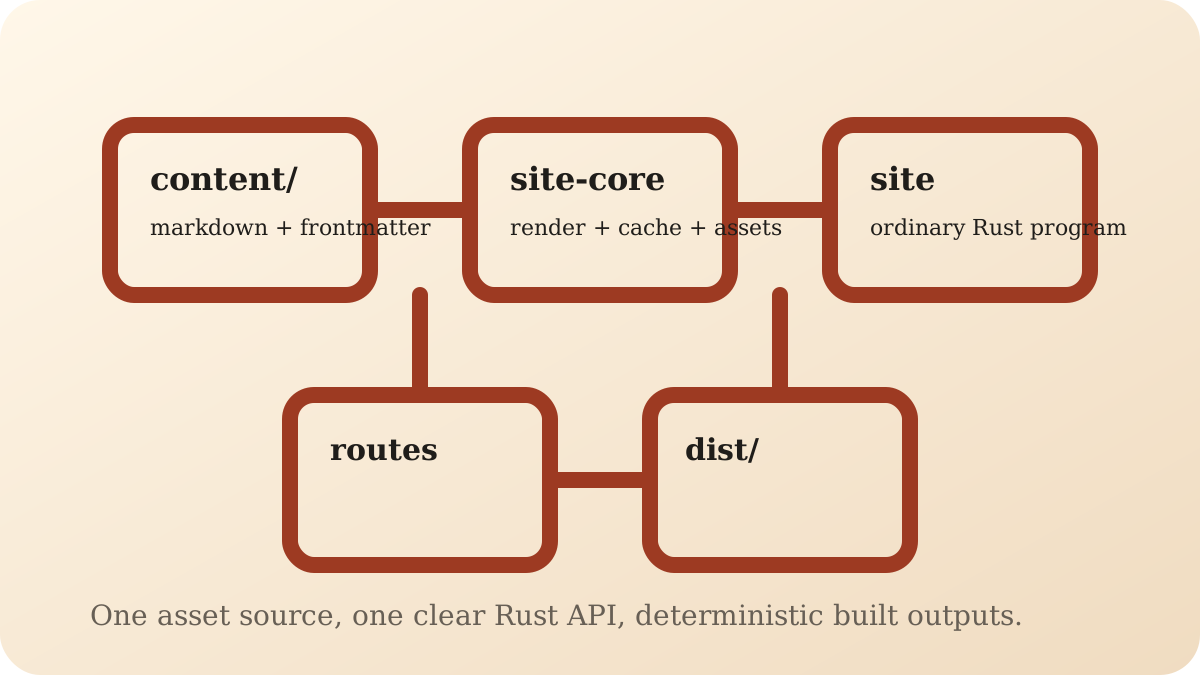
Caching is only trustworthy when you can see what happened
Incremental builds are great when they work and maddening when they feel opaque.
That is why the framework now returns a BuildReport from Site::render_to(...).
The report answers questions such as:
which routes were emitted?
which ones were skipped?
why was a route rebuilt?
which public assets were transformed versus restored from cache?
which requested asset operations had to degrade safely?
which stale outputs were removed?
The public API surface
The main API pieces are:
Site::render_to(...)BuildReportRouteBuildRecordRouteBuildStatusBuildReasonAssetBuildRecordAssetBuildStatusBuildWarningAssetWarningRecord
That gives the incremental-build system an observable public result instead of only terminal text.
Route results and asset results are tracked separately
The build report has separate records for:
route outputs
generated public assets
non-fatal build warnings
removed outputs
That distinction matters because a build can skip a route render and still need to restore missing
files under dist/assets/.
If the report only tracked "routes built or not", that nuance would disappear.
Warnings matter for a different reason: sometimes a build should keep going, but still tell you that one requested result had to degrade safely. The current adaptive-HDR asset path is the first example of that.
Invalidation reasons are explicit
When a route is emitted, the report also carries a BuildReason.
That makes cache behavior explainable:
new route
output missing
program changed
handler changed
output path changed
dependency changed
route manifest changed
This is especially useful when a route rebuild was correct, but not obvious at first glance.
Warnings are about degraded outcomes, not noisy internals
The warning surface is intentionally consequence-oriented.
If the asset pipeline cannot safely derive every adaptive-HDR auxiliary structure, the report does not dump raw metadata trivia into the public API. Instead it tells you the user-visible outcome: for example, that an HDR AVIF output was produced but synthesized gain-map derivation was skipped.
This is not only for the human CLI
The report is also useful to:
tests that want to assert incremental behavior
custom CLIs that want a more structured summary
deployment or preview tooling that wants to react only to actual work
CI checks that want to fail or notify on degraded-but-non-fatal outputs
That is why the data is returned as a Rust type instead of being only printed as terminal text.
Make the build graph observable
The broader point is that the incremental system should not feel magical.
A build engine that records dependencies but cannot explain its decisions is much harder to trust. The build report is part of making those internal decisions visible at the API boundary.
Where to go next
Read Inspect build reports for the task-oriented version.
Read Site-building API for the exact API shape.
Read Generated Routes, Pagination, and Route Metadata if you want the route-family side of incremental behavior too.